Key takeaways
- Nonprofit auto repair ministries and ministries exist in most mid-size and larger cities, often run by churches, and typically prioritize working families.
- Community Action Agencies sometimes fund emergency car repair as part of broader self-sufficiency or transportation assistance programs.
- Vocational and community college automotive programs offer discounted repairs performed by supervised students — a genuinely underused option.
- 211 is the fastest way to find whatever's currently funded and active in your specific area.
Table of contents
- Faith-based and nonprofit repair ministries
- Community Action Agencies and workforce programs
- Vocational school and community college repair programs
- General charitable emergency funds
- Free repairs you might be missing: recalls and warranties
- Which repairs to prioritize when money is limited
- Stretching a repair budget further
- Related guides
- Frequently asked questions
Faith-based and nonprofit repair ministries
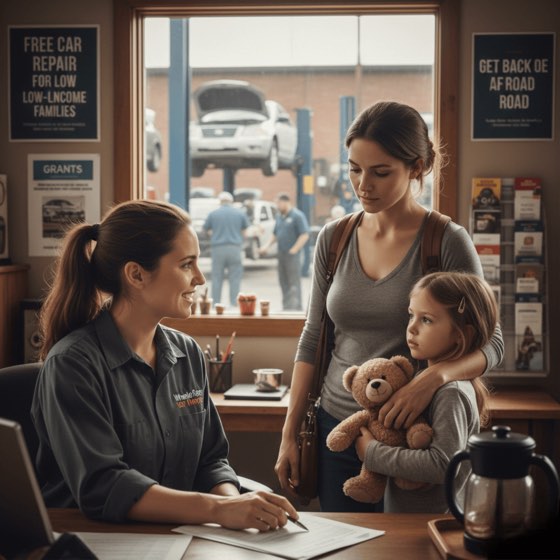
A specific and often overlooked category of assistance: nonprofit and church-run auto repair ministries that perform free or heavily discounted repairs for working families who can't afford a shop's labor rates. These often operate on a set schedule (a Saturday repair clinic, for instance) staffed by volunteer mechanics, and prioritize repairs that keep someone employed — a failed alternator or bad brakes rather than cosmetic issues. Availability is entirely local; search "[your city] car repair ministry" or "[your city] free car clinic," or ask at any large church in your area, since many run these programs without heavy online advertising. Some of these clinics operate nationally under a shared model — search specifically for "Cars for Christmas" or "Mechanics on a Mission" style programs alongside your local search, since chapter-based repair ministries sometimes coordinate under a broader organizational umbrella even while running independently city to city.
Community Action Agencies and workforce programs
Beyond LIHEAP and housing assistance, many Community Action Agencies fund emergency car repair specifically when a working vehicle is required to keep a job or complete job training — this sometimes flows through TANF-funded transportation assistance or WIOA job training support. The eligibility test is usually tied to employment or active job training, not general need, so be specific when you contact your local CAA: "I need my car repaired to keep my job" is a stronger opening than a general repair request. Find your local CAA through the Community Action Partnership locator.
For more specifics, see our guides on how this works specifically in Texas and help if the issue is the payment rather than a repair.
Vocational school and community college repair programs
Many vocational schools and community colleges with automotive technology programs offer real repairs to the public at a fraction of shop labor rates — students perform the work under instructor supervision, parts are billed at cost, and labor is often free or minimal. This is a genuinely underused resource: search "[your local community college] automotive program public repair" to see if one operates near you. Turnaround is often slower than a commercial shop since it's tied to class schedules, so this fits better for a planned repair than an emergency breakdown.
General charitable emergency funds
Beyond auto-specific programs, general hardship charities regularly fund car repairs as part of their broader emergency assistance mission, since a working car is often the single point of failure keeping someone employed. Modest Needs Foundation, Catholic Charities, and the Salvation Army all fund one-time emergency grants that can be applied toward a repair bill, paid directly to the shop. Our hardship grants guide covers how to approach each of these. Dial 211 as your fastest way to find whichever of these currently has active local funding.
Free repairs you might be missing: recalls and warranties
Before seeking any charitable assistance, check whether the repair is actually free through a channel you already qualify for. Every vehicle has a Vehicle Identification Number (VIN), and checking it against the NHTSA recall database is free and takes under a minute — manufacturer recalls are repaired at no cost regardless of the vehicle's age or whether you're the original owner, and many drivers never check simply because they assume recalls only apply to brand-new cars. Separately, if your car is still within its original powertrain or emissions warranty period (often 5–10 years depending on the manufacturer and component), a dealership repair for a covered part costs nothing even if you didn't buy the car new. Both of these are worth ruling out before applying anywhere for repair assistance, since they require no application or waitlist at all.
Which repairs to prioritize when money is limited
When only partial assistance is available, prioritizing safety- and reliability-critical repairs over cosmetic or comfort issues stretches limited help the furthest. Brakes, tires, and steering components affect safety directly and are usually what charitable programs prioritize funding first. Anything that causes a vehicle to fail state inspection (in states that require one) or risks a breakdown that strands you — a failing alternator, a worn timing belt, a check-engine light tied to an emissions component — comes next, since these tend to escalate from an affordable repair into a much costlier one (or a totaled engine) if ignored. Purely cosmetic issues — a dent, a cracked interior panel, worn upholstery — can almost always wait, freeing assistance dollars for what actually keeps the car running and legal to drive. When you're explaining your situation to any assistance program, leading with the safety or job-related consequence of the repair — rather than simply describing the mechanical symptom — tends to align your request with what these programs are actually designed to prevent. Keeping a simple log of past repairs and their approximate cost also helps you and any program spot a pattern — a car needing frequent, expensive fixes may signal it's approaching the point where repair assistance is a stopgap and a longer-term replacement conversation, covered in our free cars guide, is worth having sooner rather than later, before a series of smaller repairs adds up to more than the vehicle is ultimately worth.
Stretching a repair budget further
A few practical moves reduce what you need assistance for in the first place: get a written estimate from more than one shop before committing (prices vary more than people expect for the same repair), and ask specifically whether a used or reconditioned part fits instead of new. Combined with the assistance sources above, these steps often close the gap between what a family can afford and what a full assistance grant would need to cover, making the total cost of ownership meaningfully more manageable overall for most households.
Related guides
- Free car repair for low-income families in more depth — Additional programs and eligibility details beyond what's covered here.
- Emergency car repair assistance for urgent breakdowns — A more time-sensitive version of this guide, for situations that can't wait.
- Broader financial assistance for car repairs — Additional funding sources and financing comparisons.
Frequently asked questions
Are there really free car repair programs for low-income families?
Yes, though they're local and vary by area — church-run repair ministries, Community Action Agency emergency assistance tied to employment, and vocational school automotive programs are the three most consistent sources nationwide.
What's the fastest way to find car repair help in my area?
Dial 211 for a current referral to whatever's actively funded locally, and contact your county's Community Action Agency directly, specifically mentioning that the repair is needed to keep a job.
Do community college auto programs really fix cars for the public?
Many do, as part of student training — labor is often free or minimal since students perform the work under instructor supervision, though turnaround is typically slower than a commercial shop.
What if the repair is too expensive for any assistance program to fully cover?
Get written estimates from multiple shops (prices vary significantly for the same repair), check if a recall covers it for free, and consider whether a smaller loan for the remainder makes sense compared to losing income from an unreliable car.
Will car repair assistance programs help with routine maintenance, or only breakdowns?
Most programs prioritize repairs that address an actual breakdown or safety issue over routine maintenance like oil changes, since limited funding is typically reserved for situations where a vehicle is currently unsafe or undrivable. That said, some Community Action Agency programs do fund preventive maintenance specifically when it's framed as avoiding a much larger future repair.
Estimates are informational only, not financial advice or an offer of credit — see our disclaimers.
Before you apply: program rules, amounts, and deadlines change. Always confirm details with the official agency or program administrator. Applying for government benefits is free.
National Relief Program is an independent guide, not a government agency. Spotted an error? Email support@nationalreliefprogram.org.